Stages
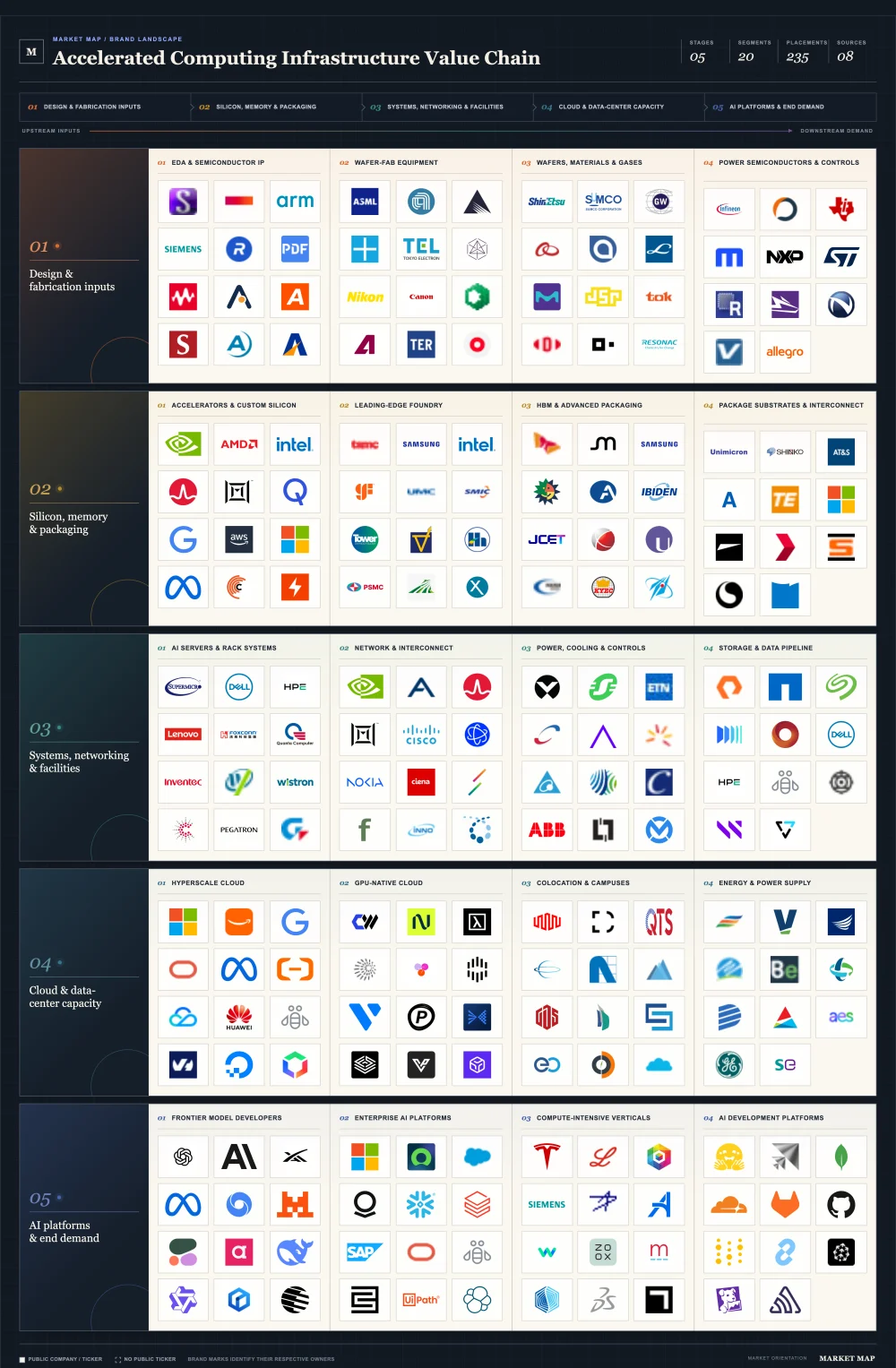
The major steps from upstream inputs to downstream demand.
Value chain mapping
A value chain map organizes the companies and capabilities that move a product or market from upstream inputs to downstream demand. It turns a long list of names into a structured view of who does what—and where each company fits.
Build a value chain mapComplete example
Accelerated Computing Infrastructure
Trending market reports · August 2026
Selected from current public-market activity, then mapped from upstream inputs to downstream demand with a visible source trail.
Data-center demand is reshaping orders for transformers, switchgear, substations, turbines, and grid interconnection equipment.
Repeated attempts to restore reliable transit are moving crude, LNG, tanker, refining, and fuel-sensitive equities across multiple trading sessions.
Banks and payment providers are moving from pilots toward managed stablecoin settlement, treasury, and global payout networks.
New satellite launches and mobile-operator partnerships are moving direct-to-phone connectivity toward commercial service.
Defense, drones, robotics, and electrification are accelerating the rebuild of mine-to-magnet supply chains outside China.
AI workloads are turning memory bandwidth, flash performance, and mass-capacity storage into one connected infrastructure bottleneck.
AI factories are pulling photonics, fiber, lasers, and high-speed interconnect into the center of the infrastructure buildout.
Research library
Published research overviews are open to everyone. Create a free account to explore the complete interactive library.
Free account access
Public research pages show the market structure, leading companies, and source trail. Sign in to inspect the interactive maps. Downloads remain a Pro feature.
What it shows
Traditional value chain analysis often describes the activities inside one company. A market value chain map takes an external view: it identifies the stages of a market, separates those stages into decision-useful segments, and places relevant companies inside each segment.
This makes the map useful for market research, investment preparation, competitive analysis, partnership discovery, and understanding how changes in one part of a market may affect the rest of the system.
The major steps from upstream inputs to downstream demand.
Distinct capabilities, products, and roles inside every stage.
Category leaders, specialists, challengers, and emerging players.
Primary materials and official references attached to the map.
Popular starting points